What is TPMS? Tyre sensors and the most underrated screen in your car
What TPMS is, why many countries made it mandatory, how indirect and direct systems differ, and the unencrypted radio packets your tyres send out.
If you’ve ever driven a car, you must have seen this or a similar kind of display.
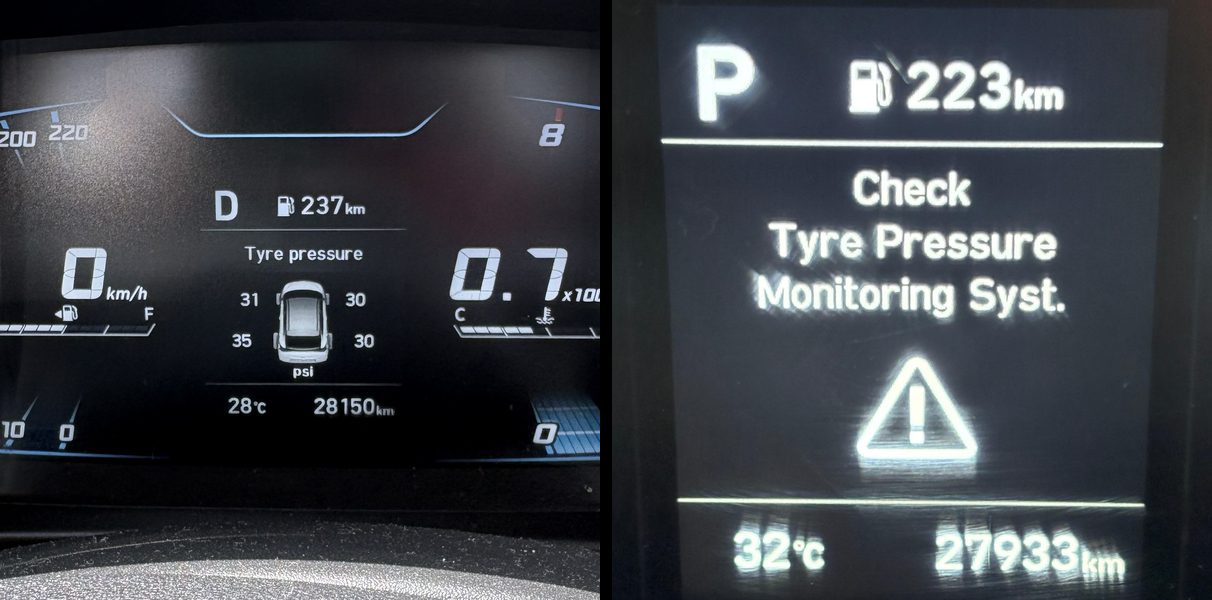 Left: the tyre pressure screen. Right: the warning I got when one of my sensors broke.
In my opinion, this is the most underrated display in cars. It is usually hidden in the settings somewhere. In my car, I have to press the mode button a few times before I even get to this screen. The warning screen, as shown in the image, also pops up on its own when something goes wrong, like a tyre losing pressure or a problem with the system itself. In my case, it was the second one. One of my sensors broke, and the car flagged it as a system fault. Normally, it shows the air pressure of each tyre, like in the image above.
It is necessary to monitor this on a regular basis to keep your tyres in good condition and make them last longer. It is also quite important for safety, as under or over inflated tyres can cause loss of control and lead to accidents. This is the reason why many countries have made the Tyre Pressure Monitoring System (TPMS) mandatory in cars. For example, in the United States, China and the EU, it is mandatory for all new cars.
The US was the first to do this. The TREAD Act was passed in 2000, after a series of Ford Explorer rollovers in the late 90s were linked to tyre failures. FMVSS 138 is the actual rule that came out of it. It says the warning light must come on when a tyre drops 25% below the pressure written on the sticker on your door.
The EU made it mandatory for all new passenger cars sold from November 2014, under Regulation 661/2009. China did the same with GB 26149-2017, and from January 2020 every new passenger car there needs one.
India is a different story. There is a standard, AIS-154, which tells manufacturers how a TPMS must behave if they fit one. But as of writing this, it is not mandatory for all new cars. My i20 has it because Hyundai chose to put it in, not because of the law.
But before we get into the details, it helps to know that there are essentially two types of TPMS.
Kinds of Tyre Pressure Monitoring Systems (TPMS)
1. Indirect TPMS
This is a system where the car uses the wheel speed sensors that are already there for the ABS (Anti-lock Braking System) to figure out the tyre pressure. Wait… but how do you take the wheel speed and get the pressure of the tyre?
This is where we use physics.
Inflating or deflating a tyre changes its diameter. Inflating increases it and deflating decreases it. Now, an under inflated tyre has a smaller diameter, so it must spin faster than the other wheels to cover the same distance as the properly inflated tyres. Similarly, an over inflated tyre must spin slower to cover the same distance. The ABS control unit senses these slight changes in wheel speed to see if a tyre is inflated properly or not. It does not measure the actual pressure, but it can tell when one tyre is off compared to the others. On your car display, it would not show the exact pressure value. Instead, it would just say that one of your tyres is underinflated. You can see one example in the image below. This saves cost, as there is no extra hardware needed inside the wheels. Because of this, many cars still use it today, especially cheaper ones. Some carmakers, like Audi, Honda and Mazda, even switched to it in the early 2010s.
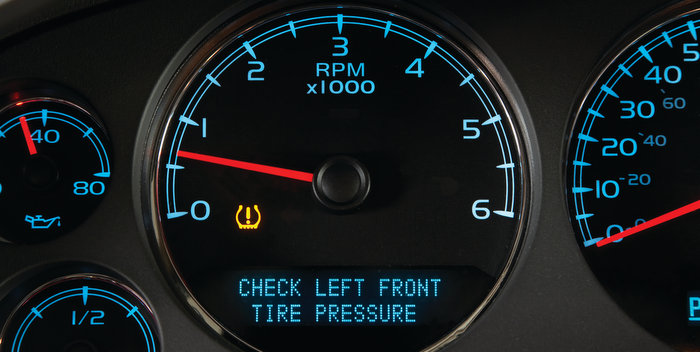 An indirect TPMS warning on the instrument cluster. Image: Tire Review.
But there is a catch. Since it only compares the wheels to each other, if all four tyres lose air slowly at the same rate, they all keep spinning at the same speed and the system does not notice anything. This was a big enough problem that a US court struck down the first version of FMVSS 138 in 2003, because it allowed systems that could miss exactly this case.
2. Direct TPMS
This is the kind of system my car has. Here, each wheel has its own small sensor inside the tyre, usually attached to the back of the valve stem, the valve you use to fill air. The sensor measures the actual pressure and temperature inside the tyre, and unlike the indirect system, it does not have to guess.
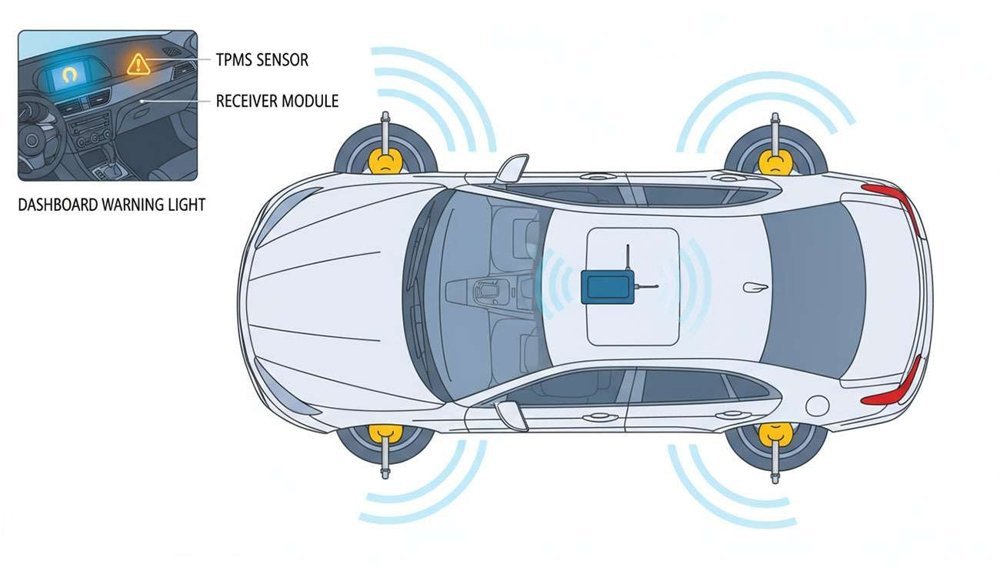 Direct TPMS: a sensor in each tyre talks to a receiver in the car. Image: Performance Plus Tire.
The sensor runs on a small battery sealed inside it. The sensor is designed to run without draining the battery for 5-10 years. You cannot change the battery, so when it dies or the sensor breaks, you replace the whole thing. That is exactly what happened with mine.
So how does the sensor send the pressure data to the car? It cannot use a wire, because the wheel is spinning and you can’t attach a wire to a spinning wheel without using a complex mechanism. Instead, it sends it over a radio signal to the control unit. In India and Europe, this is usually on 433.92 MHz, and in the US it is usually 315 MHz. While you are driving, each sensor periodically sends a small packet containing the pressure and temperature data to the car’s control unit, which in turn decodes the packet and displays it on the car’s display unit.
And here is the interesting part. These packets are not encrypted. Anyone with a cheap radio can listen and capture these packets. That is what the rest of this series is about.
Coming up in this series:
- What is inside the sensor hardware
- Replacing the broken sensor in my car
- Why the sensor measures temperature
- Collecting this data using cheap hardware and doing all kinds of data analysis on it
Stay tuned.