The various modes of a tyre sensor
A tyre sensor is smart. It can change what it transmits based on the situation.
In the last post we found where the pressure and temperature bytes live inside the packet. We did this by doing a series of experiments on my car and figuring out which fields represented which using a trial and error approach. But there was still one byte left in the packet of 9 bytes which didn’t change that much, and we still did not know what it represented. In this post, we will see another set of experiments that helped decode part of this byte and shed new light on what the various modes of a tyre sensor are.
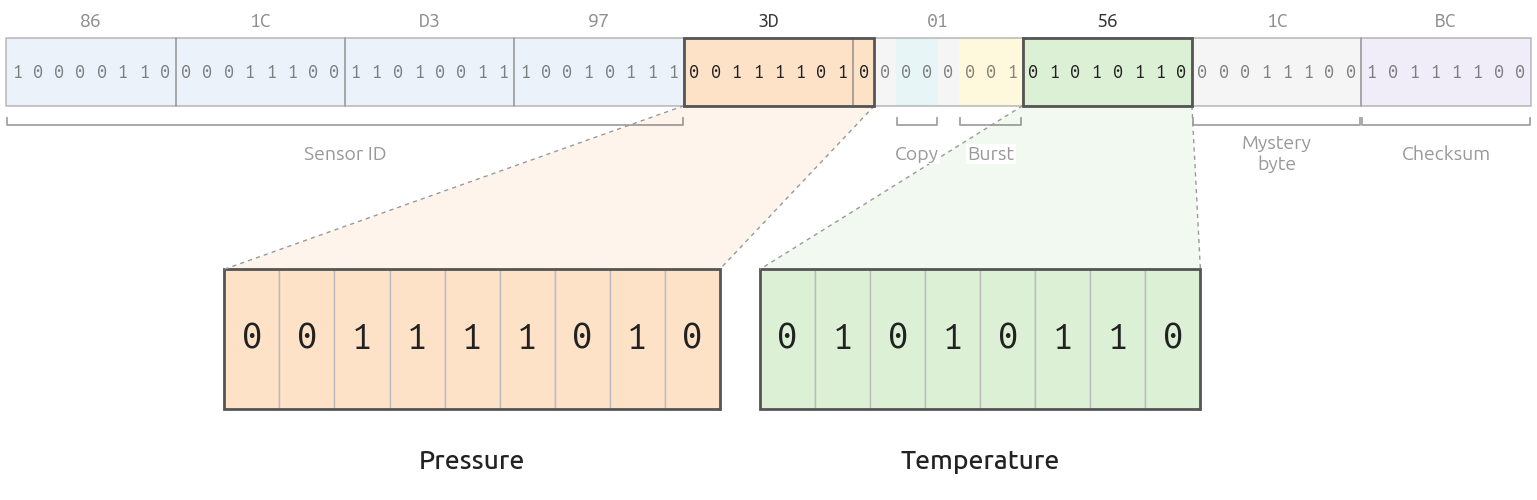 The pressure and temperature fields from the last post, and the mystery byte that is still left
What the FCC filing says
Every radio sold in the US has to be tested, and the test report for my sensor is public on the FCC website. I have already used it in Part 2 to look at the internals of the sensor hardware and some details on its transmit frequencies. What is also interesting in this document is a section which shows us the different conditions under which the sensor transmits and the operating modes as shown below.
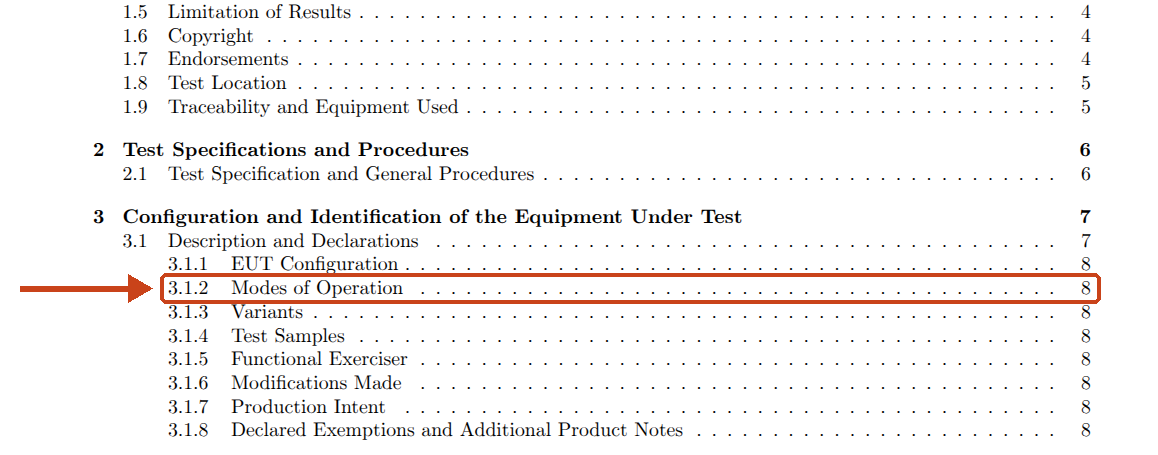 The modes of operation section in the table of contents of the FCC test report
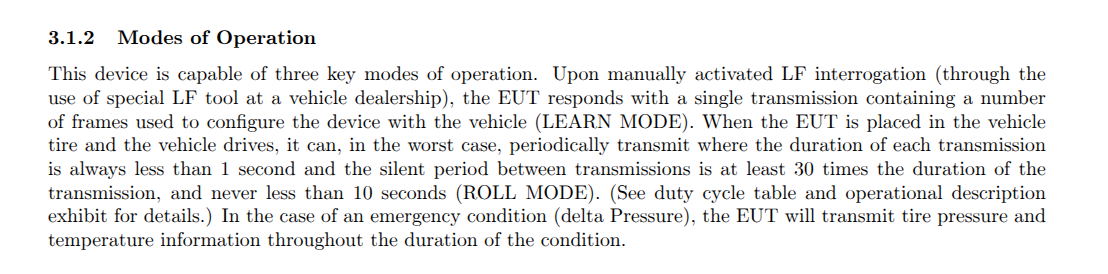 The modes of operation section in the FCC test report for my sensor
The report describes three modes:
Learn mode. This mode is useful when we need to trigger the sensors manually. Remember, the sensors do not transmit unless the car starts to move and over a speed of around 15-20 km/h. That is fine while driving around, but what happens when you have to test a sensor in a workshop? Obviously, you can’t just drive the car at that speed in a workshop. This is where the learn mode becomes useful. A TPMS trigger tool, like the ATEQ VT55 used in the first big research paper on TPMS security, wakes the sensor up when held close to it. Whenever we press a button on it, it sends a low frequency (LF) signal at 125 kHz, and the sensor answers with one burst of four packets. This is also how a new sensor gets paired with the car, like the one in Part 2.
Roll mode. This is the normal mode while driving. The sensor sends a burst of four packets every 20.3 seconds in the worst case, according to the report. In my car, it was around 21 to 23 seconds. The FCC rules say the sensor has to stay quiet for at least 30 times as long as it transmits, and never less than 10 seconds.
Emergency mode. When the pressure changes quickly, the sensor detects this, stops waiting and keeps transmitting the pressure and temperature for as long as the change lasts. Why do this? Imagine you had a flat tyre and the sensor transmitted a minute later. You could have been in a serious accident before the alert arrived on the dash. Also, if you can see the alert immediately, you can take preventive measures.
The report also has a table and plots for the learn and roll modes. In both, the sensor sends the same four packets, each 9.34 ms long and about 130 ms apart. The only difference is what scenario makes it transmit.
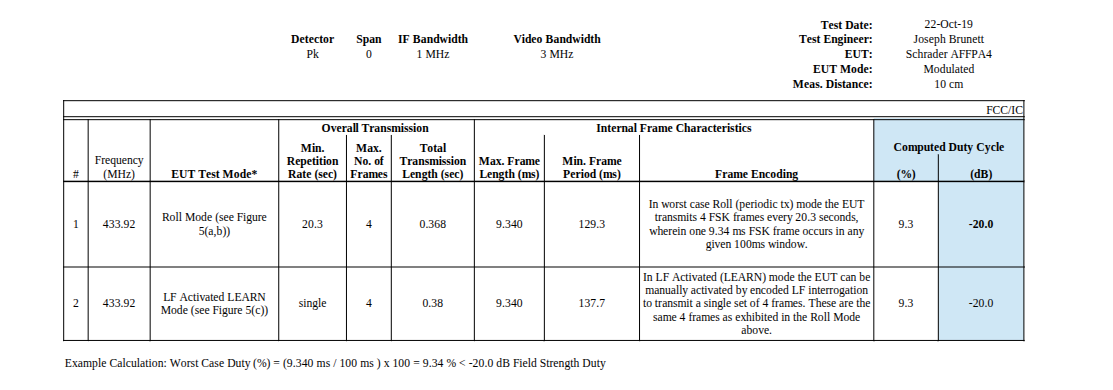 The duty cycle table from the FCC test report
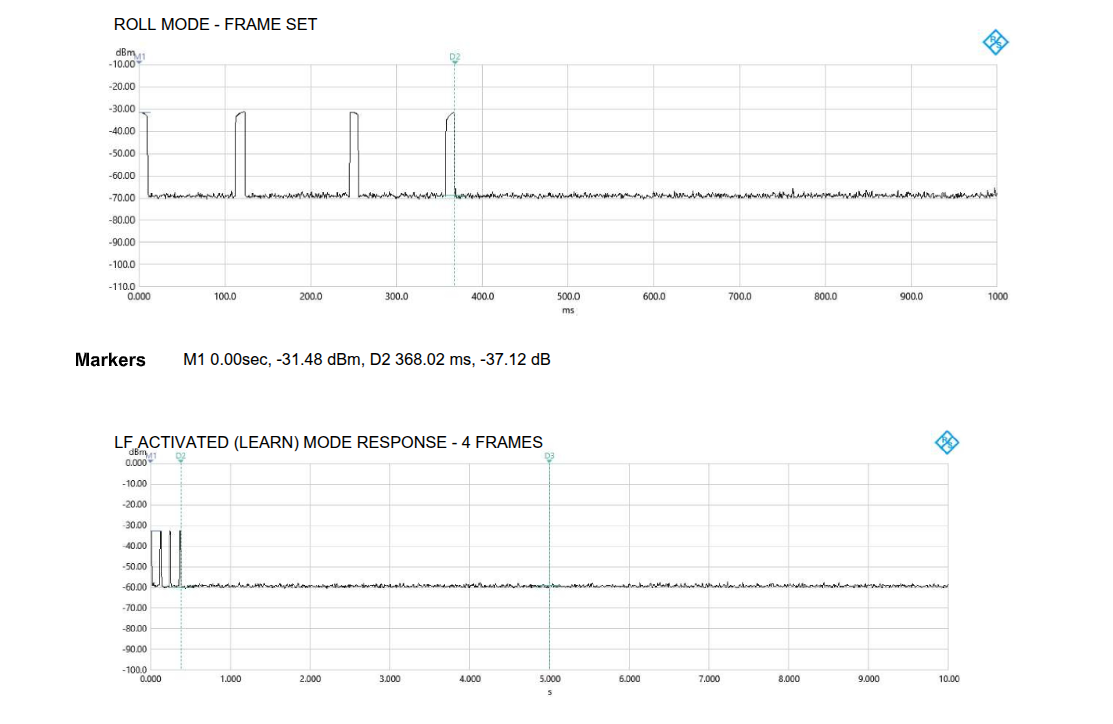 Four packets in roll mode (top) and in learn mode (bottom), from the FCC test report
Roll mode is easy, it’s what I have been recording all along. Learn mode needs the workshop tool, which is really expensive, and I don’t really have one. Emergency mode needs a tyre that is losing air. This is doable, right? Yes! And that is where I started.
Letting the air out of my tyre
On one morning, before driving anywhere, I measured all four tyres with my digital tyre pressure gauge. The rear-left was at 35 psi, a bit higher than the others. This was a good reference point, as we can easily see in the data which one is higher than the others. I came across a post on the rtl_433 community about someone triggering their car’s emergency mode by letting the tyre’s air out rapidly. And so I tried that. What do we have to lose, right? Worst case, I go to a nearby workshop and get my air topped up.
I started the IQ recording with my RTL-SDR and laptop setup on one of my car seats and sat next to the car tyre letting the air out. Remember we can use the rtl_433 tool itself to record IQ files for us.
But how do you monitor the tyre pressure while you are letting air out? You can’t just leak air for a few seconds, stop and measure pressure using the digital gauge and then repeat. I didn’t know if my car would treat this as an emergency mode. This is where I had to get a little creative. I held the analog gauge’s needle at an awkward angle. Instead of a tight seal, I held it loosely. This way, it let out air and measured pressure as well. Although it was not going to be accurate, this was fine to see the pressure drop.
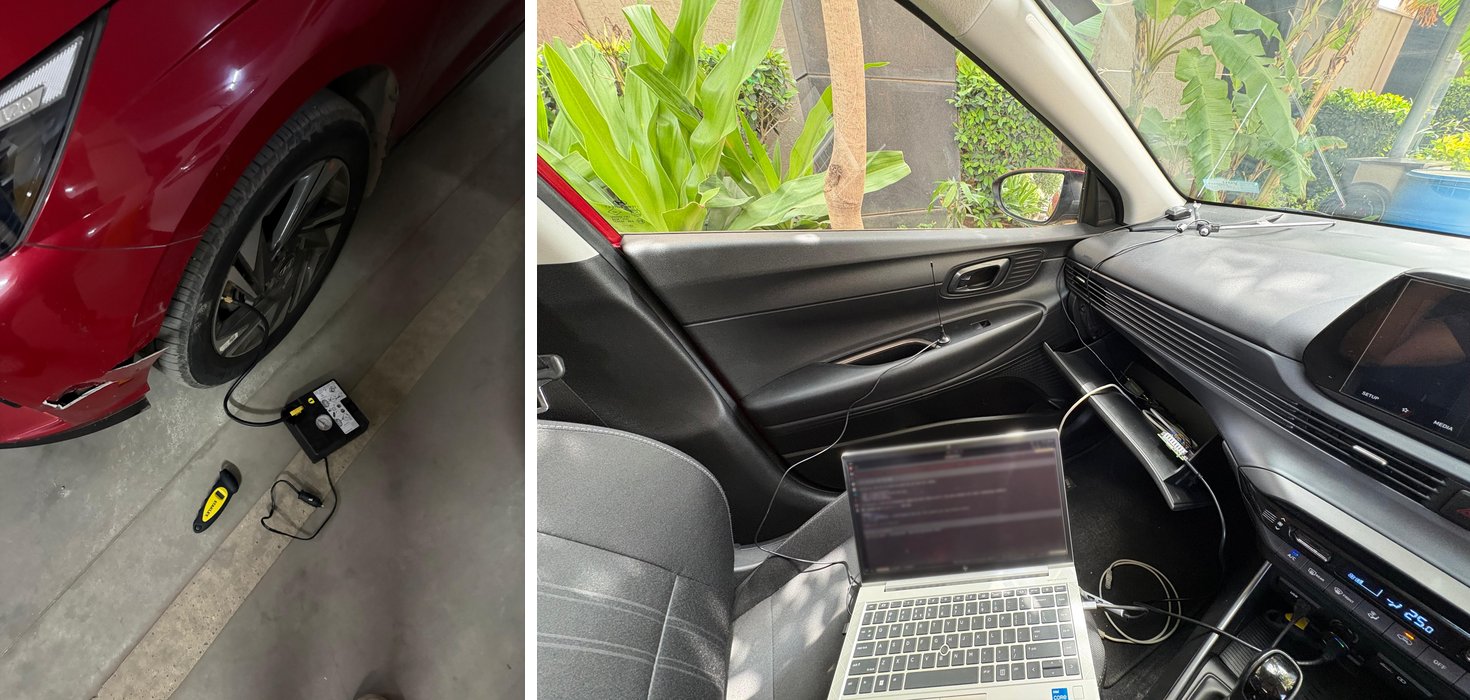 Left: air being let out using the analog gauge on my front tyre. Right: the laptop on the passenger seat, recording IQ files
It dropped about 6 psi in one go, much more than I expected, so I stopped there. The tyre pressure read about 29.0 psi after this whole exercise.
Looking at the data from this exercise, the sensor sent 8 packets within about a second, without waiting for its usual 20s. I knew this was a totally different pattern to what I see while driving. Emergency mode decoded!!!
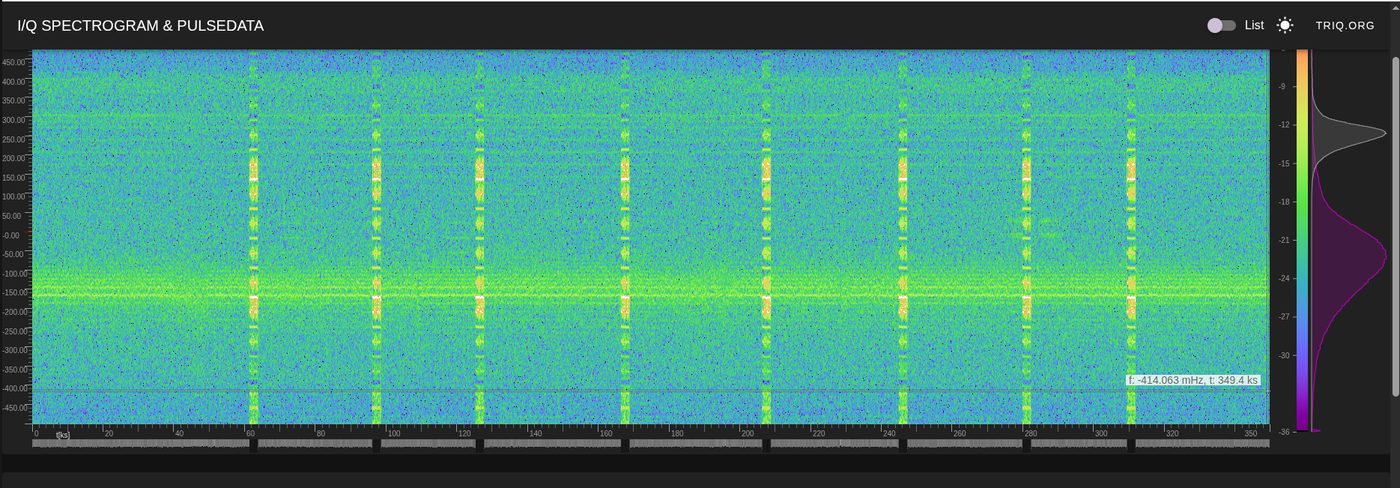 The 8 emergency packets from my rear-left tyre in the triq.org spectrogram tool, all within about a second
The workshop made it bigger
After this little experiment, I went to the workshop to get my tyre topped up. And I wanted to keep recording the IQ data there as well just to see my tyre getting topped up. This turned out to be lucky. By mistake, the person at the shop accidentally fully deflated the front-right tyre. I did not notice this and neither did the person over there. I just left after thinking the tyres were fully topped up. After driving a few minutes, I realized something was wrong and noticed my dash only to see that the front-right was showing 0 and blinking indicating a warning. I went back to the shop to get it fixed.
I came back home and checked the data. This was a treasure trove.
The sensor reported the whole thing. A new emergency burst came about every 22 seconds, each one lower than the last: 23.75, 17.5, 12.5, 8.25, 4.75, 2.5 psi and then a raw value of 0. This was expected as we know it transmits when a tyre is leaking.
But what is interesting is that, when they refilled it, emergency mode fired again, this time on being inflated, and much faster: a burst every 2 to 5 seconds, going 13.5, 19.25, 26.0, 30.0 and 32.25 psi in about 15 seconds. So the sensor doesn’t only care about air loss. It reacts to any quick change, and the faster the pressure changes, the more often it transmits.
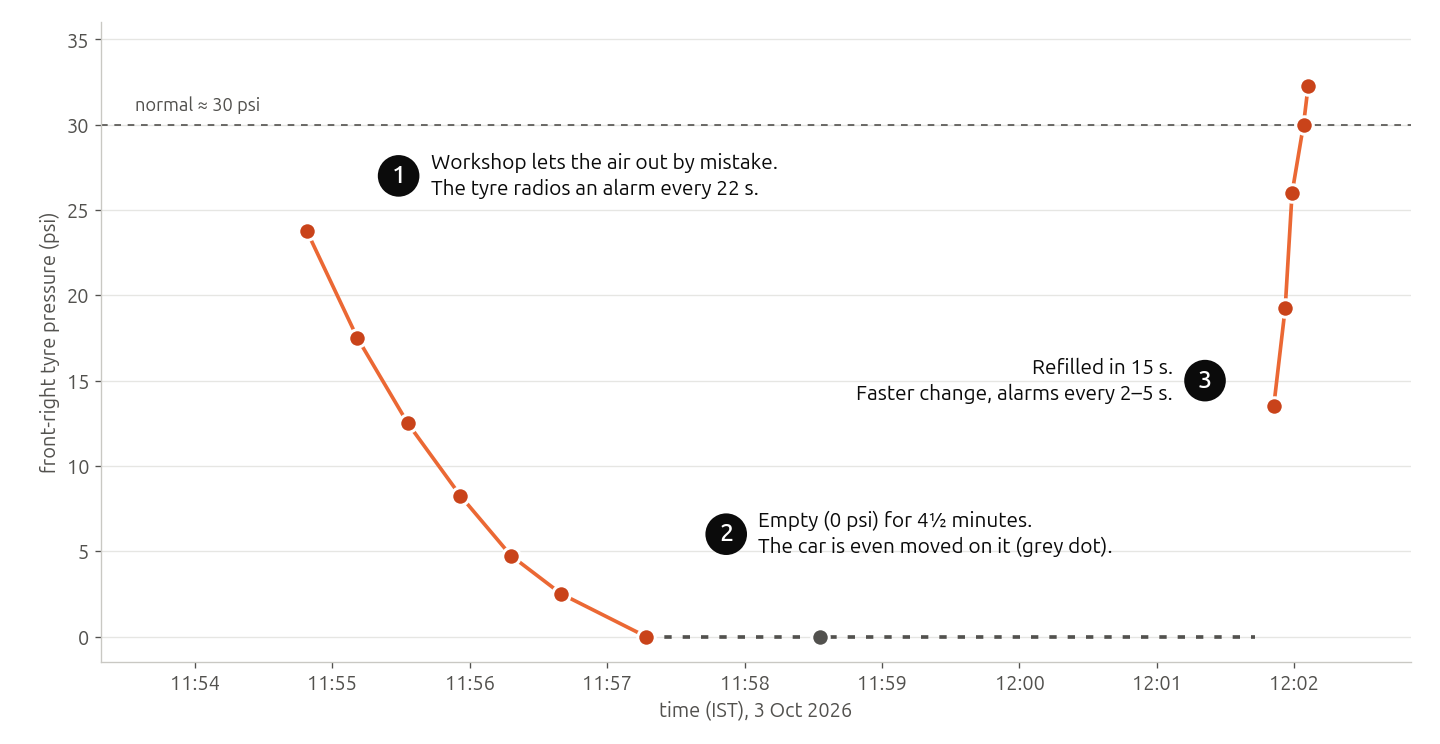 Every orange dot is an emergency burst from the front-right tyre. The grey dot is a normal packet sent while the car moved on the empty tyre
The mystery byte
So which byte tells us that a packet is an emergency one? I compared the emergency packets with the normal ones from the same tyre. The ID, pressure, temperature and checksum were all where we expected them. But the eighth byte, our mystery byte, was 01 in every single emergency packet, during the leak, the deflation and the refill. In months of normal driving, I had never seen that value. Here is one of the packets from my little experiment:
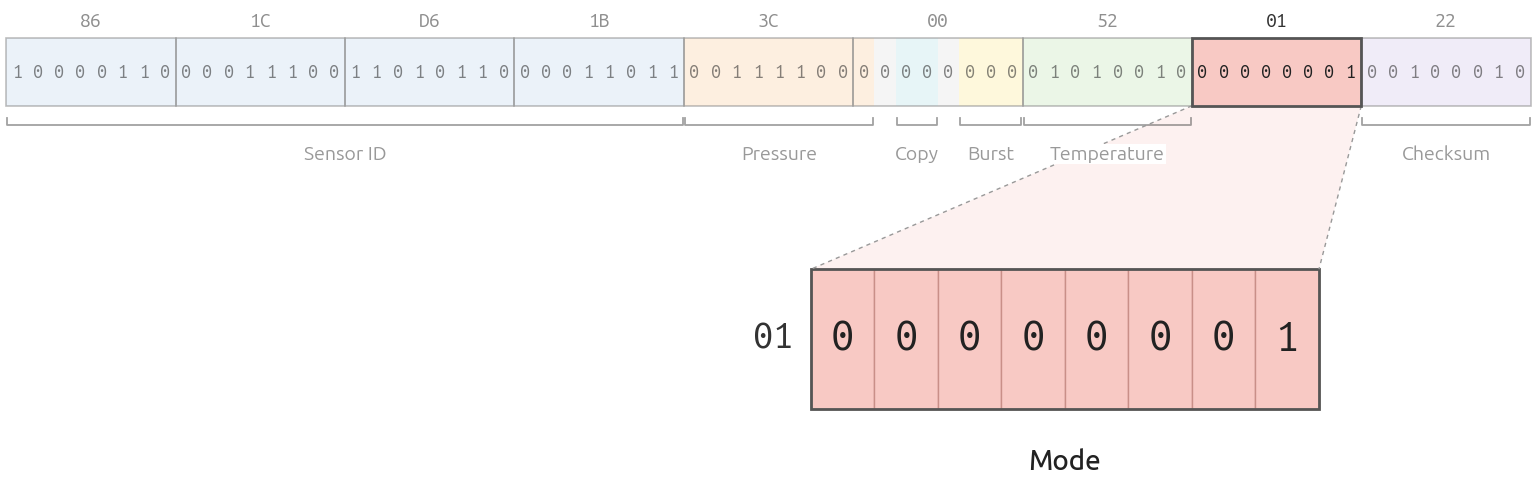 An emergency packet from my rear-left tyre, with
01 in the eighth byte. The other fields are the same as in the last post
The copy counter and the burst number are also different. In a normal burst, they count up from packet to packet, but in all 8 emergency packets they stayed at 0.
So 01 is the emergency mode. What about the others? We saw the rolling mode being set to 1c or 1d during drives. Apart from this, I also saw 0e. I don’t know what this means so far.
| Value | Bits | What I think it means |
|---|---|---|
1c | 00011100 | Roll mode, normal driving |
1d | 00011101 | Roll mode, during hard acceleration or braking (not confirmed) |
0e | 00001110 | Unknown, single packets instead of bursts of four |
01 | 00000001 | Emergency mode, quick pressure change |
1d is a guess for now. On one of my drives, I lined up the packets with the GPS on the Raspberry Pi in my glovebox, and 1d showed up when the speed was changing quickly, while braking or accelerating hard. That’s just one experiment, so I can’t be sure yet. More experiments to come soon.
0e is another one that is strange. Those packets came alone, not as a burst of four. I first thought it meant the car was parked, but the GPS showed the car moving. It may be some kind of keep-alive, but I don’t know yet.
Try it yourself
You can see and play around with the same kind of modes in other sensors in the Packet Lab tool that I have designed. The public recordings there include a Toyota sensor waking up and a Subaru sensor sending a pressure change alarm.
Coming up
Coming up in this series:
- Contributing my decoder to rtl_433
- Building a surveillance lab in my glovebox to collect data on every drive
- Why the sensor measures temperature
- Doing all kinds of data analysis on the data collected
Stay tuned.
Further reading
If you want to dig deeper into some of the ideas in this post, these are the documents I found most helpful:
- Security and Privacy Vulnerabilities of In-Car Wireless Networks: A Tire Pressure Monitoring System Case Study, the 2010 paper by Rouf et al. that first looked at TPMS security, including how the sensors are woken up
- FCC rule 15.231, the rules for periodic transmitters like tyre sensors